
Tube Assembly. Precision Fluid Transfer · Steel & Nylon
United Sanoh Industries engineers precision fluid-carrying tubing for Malaysia’s most demanding OEM platforms — advanced materials, exacting tolerances, zero-compromise quality.
Tubing Engineered to
Your Specification
Every tubing assembly is defined by a precise combination of material form, dimensional spec, protective treatment and end-forming — configured to meet OEM requirements exactly.
Precision Fluid
Transfer Systems
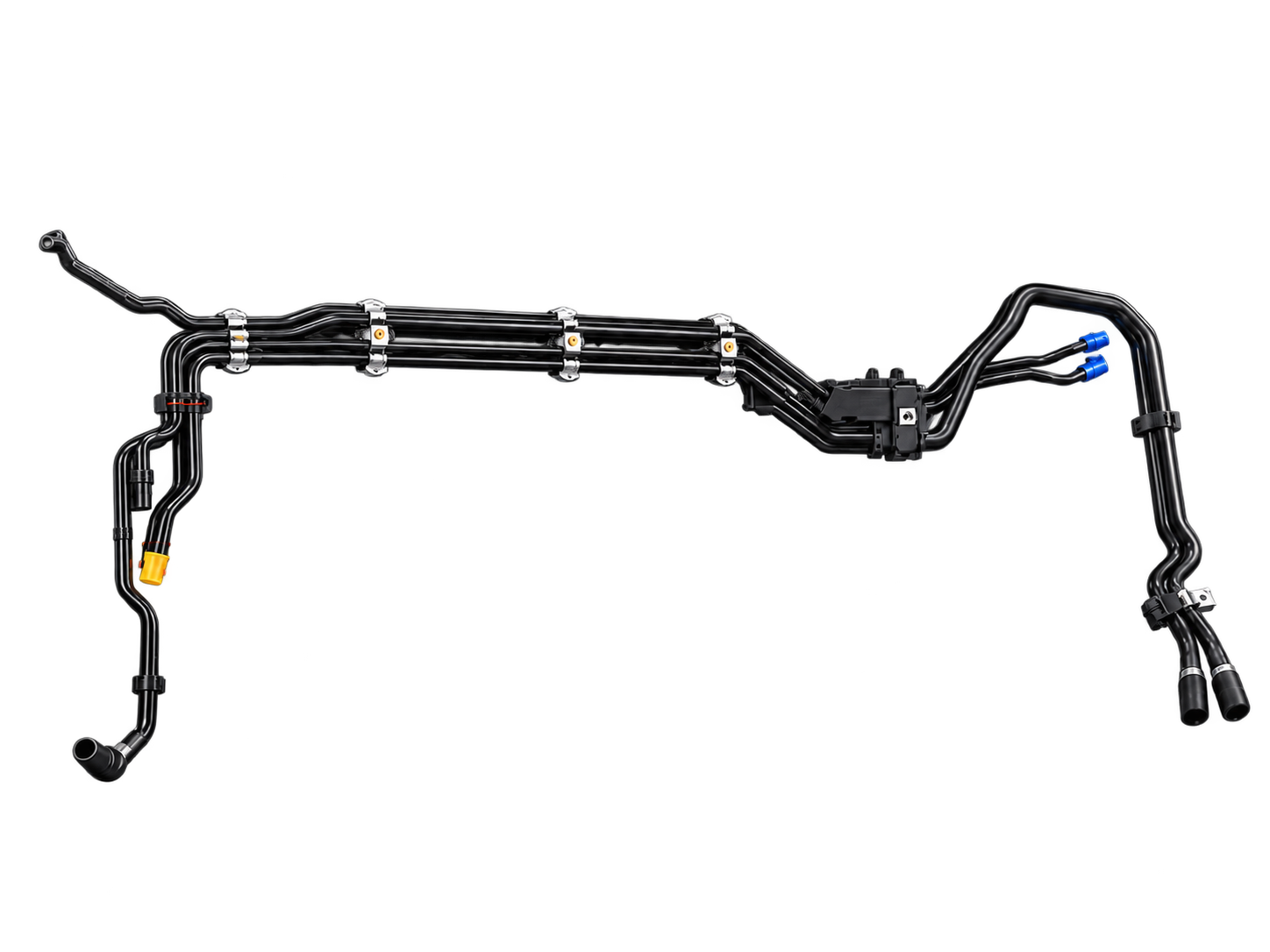
USISB manufactures precision metallic tubular systems for automotive brake, fuel, cooling, and hydraulic circuits — the small-diameter, high-integrity lines that carry fluid through a vehicle's most safety-critical systems.
"Small in diameter, critical in function — every tube is engineered to perform flawlessly across the full lifecycle of the vehicle under pressure, temperature, and chemical exposure."
Produced from double-wall brazed (DWB), single wall welded (SWW), and seamless steel tube stock, our fluid lines are formed, treated, end-formed, and 100% pressure-tested before delivery to Tier-1 and OEM assembly lines.
Steel vs Nylon
Choosing the Right Platform
Each material platform is engineered for distinct performance environments. Understanding the differences is the foundation of optimal fluid system design.
Steel Tubing
High-strength precision steel tubing engineered for critical high-pressure applications — brake lines, fuel delivery, and structural fluid routing where rigidity and burst resistance are non-negotiable.
Nylon Tubing
Advanced polyamide tubing delivering lightweight, flexible, and corrosion-immune fluid routing — purpose-engineered for HVAC, vapour, and low-to-medium pressure systems.
Precision Manufacturing Process
From raw material to OEM-ready assembly — zero defect, full traceability
Cutting
Cutting shapes raw steel tubes to the exact length required, using automated machines guided by precise engineering specs. Each tube is checked for accurate length, square edges, and clean cuts, and any with burrs, bends, or dimensional issues are rejected.
Deburring
Deburring removes sharp edges, burrs, and metal residue left behind from cutting, making the tubes safe to handle and ensuring a smooth fit during assembly. Tubes are cleaned with compressed air and visually checked to confirm both inside and outside surfaces are free of contamination.
Peeling
Peeling removes the protective coating from specific sections of the tubing, as required by customer specifications and engineering drawings. Peeling length and dimensions are closely controlled to ensure complete, clean removal without damaging the base material, while tolerances are applied based on the specified length to maintain consistent quality and dimensional accuracy.
Forming
Forming reshapes tube ends into the required geometry based on engineering drawings, using operations like expanding, reducing, flaring, or beading on dedicated forming machines. Critical dimensions—such as OD, ID, bead height, and forming length—are inspected to ensure compliance, with tolerances maintained according to drawing requirements for consistent, accurate results.
Bending
Bending shapes tubes into the precise angles, radii, and geometries required by engineering drawings, using either CNC bending machines for high repeatability or manual bending with dedicated jigs and fixtures for complex geometries that machines can't achieve. Bend angle, radius, and overall geometry are verified using checking fixtures and measurement tools, with tolerances controlled to meet drawing specifications.
Trusted by Malaysia’s OEMs
Jan 2026 to Jun 2026 delivery performance across all automotive customers.